Geography of کوردستان
Explore the four regions that form the heart of Kurdish lands
Bashur (Iraqi Kurdistan)
The autonomous Kurdish region, officially recognized since 1992. Governed by the KRG with its own parliament and military.
Bakur (Turkish Kurdistan)
The northern region encompassing southeastern Turkey, rich in ancient Kurdish heritage and traditional villages.
Rojava (Syrian Kurdistan)
Western region known for democratic confederalism and multi-ethnic governance.
Rojhilat (Iranian Kurdistan)
Eastern region rich in Persian-Kurdish cultural fusion and literary heritage.
Nature of کوردستان
Mountains, rivers, forests, and the creatures that roam free
Zagros Mountains
The backbone of Kurdistan, stretching 1,500km. Çiyayên me, parêzvanên me (Our mountains, our protectors)
Rivers
Tigris, Euphrates, Great Zab, Little Zab. Lifeblood of Mesopotamia.
Forests
Ancient oaks, pistachio, almond trees, alpine meadows. Daristan di dilê me de ye (Forests are in our hearts)
Wildlife
Wild goats, Persian leopards, golden eagles, brown bears. Ajalan azad in (Animals are free)
Culture & Cuisine of کوردستان
Language
Kurdish (Kurmanji & Sorani) - our ancestral tongue.
زمان کوردى
Ziman, nasname ye (Language is identity)
- Kurmanji: Latin script, northern regions
- Sorani: Arabic script, central regions
Traditional Clothing
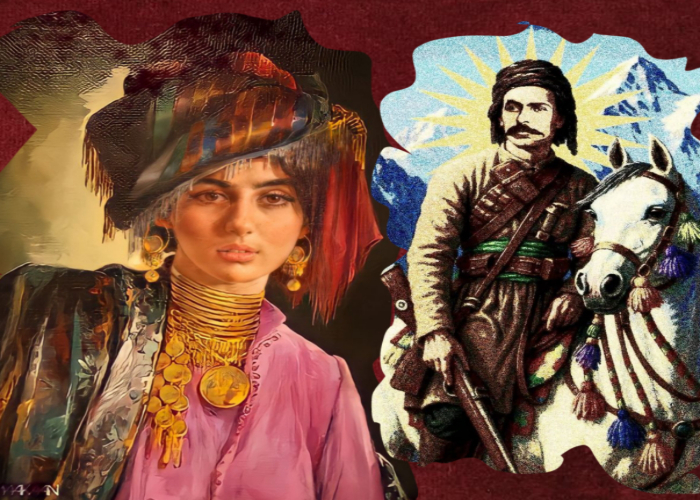
Men: Baggy trousers (şal û şepik), vests, turbans - each region has unique embroidery.
Women: Bright dresses with intricate patterns. Each color tells a story of homeland and heritage.
Literature & Poetry
Mem û Zîn: Our national epic by Ehmedê Xanî (1692). A tragic love story reflecting Kurdish longing for freedom.
Folk Tales: Stories of Kawa the Blacksmith, Zembîlfiroş, and Dengbêj bards preserve our oral heritage.
Stran, dengê bêdengan e (Song is the voice of the voiceless)
Traditional Cuisine
Festivals
Nowruz (نەورۆز): March 21, New Year. Bonfires, dancing, renewal. Sersal pîroz be (Happy New Year)
Tolbew: Harvest festivals celebrating abundance. Berhem bi xêr be (Blessed harvest)
Dance & Music
Govend: Circle dance uniting all. Govend, yekbûn e (Govend is unity)
Dengbêj: Oral history keepers preserving our stories through melody.
Traditional Instruments
Tembûr: Long-necked lute, heart of Kurdish music. Stran, dengê bêdengan e (Song is the voice of the voiceless)
Daf: Frame drum for rhythm and ceremony.
Music of کوردستان
Voices that carry our stories across mountains and time
History of کوردستان
Mitanni Kingdom, Medes, Assyrian influence. Zagros bridge between Mesopotamia and Iran.
Kurdish emirates rise. Salah al-Din al-Ayyubi (1137-1193) - Kurdish hero who recaptured Jerusalem.
Kurdish principalities (Bitlis, Botan, Bahdinan, Soran) maintained autonomy.
Republic of Mahabad (1946), KRG autonomy (1992), Rojava revolution (2012).
Politics of کوردستان
Kurdistan Regional Government
Autonomous region in Iraq with own parliament, military (Pêşmerge), and foreign policy since 1992.
Self-Administration in Syria
Rojava model: democratic confederalism, gender equality, direct democracy through communes.
Political Parties
KDP
Kurdistan Democratic Party
PUK
Patriotic Union of Kurdistan
NGM
New Generation Movement
HDP
People's Democratic Party
PYD
Democratic Union Party
PKK
Kurdistan Workers' Party
Leaders of کوردستان
Qazi Muhammad
President of Mahabad Republic
قازی موحەمەد
Mustafa Barzani
Revolutionary Leader
موستەفا بارزانی
Jalal Talabani
First Kurdish President of Iraq
جەلال تاڵەبانی
Mézlom Abdi
SDF Commander | Rojava Leader
مزلوم عبدي
Gallery of کوردستان
A glimpse into our mountains, villages, and cultural life
Zagross چیاکان
The backbone of our land
Gundê Kurdan گوندی کوردان
Where traditions live
Jiyan ژیان
Daily Kurdish life
Connect with کوردستان
Share Your Story
Your voice adds to our collective memory. Dengê te, dengê me ye (Your voice is our voice)